CATS: Crash Arena Turbo Stars
- 4.3
- Rating
- 100.00M
- Installs
- Free
- Price
 Analysis by App-foxy
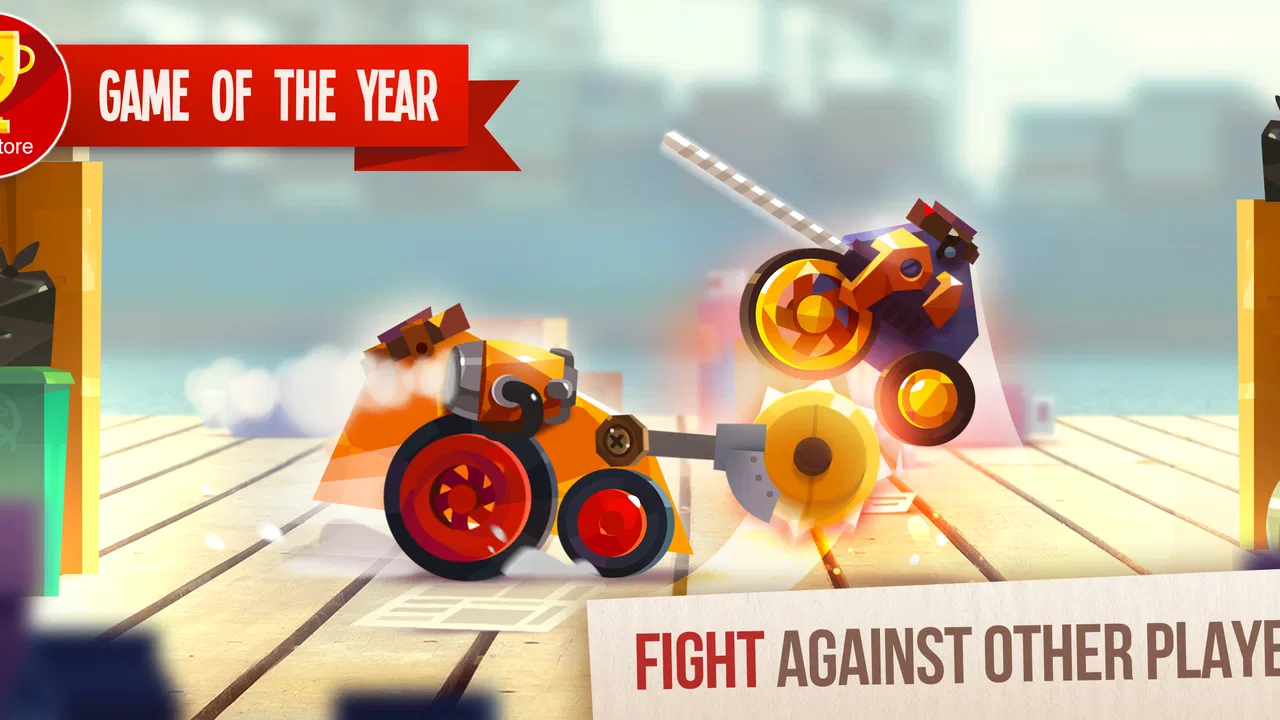
I approached CATS: Crash Arena Turbo Stars expecting a quick action game, but its real appeal appears before the first fight begins. You build a small combat machine, choose how its parts work together, and then watch the result collide with another machine. That makes it feel less like a traditional game where reflexes decide everything and more like a compact experiment in design, timing, and trial and error.
This is an action game from Nazara Publishing, available free of charge for players rated Everyone. It has reached over 100 million installs and holds a 4.3 average from around 2.8 million ratings, which helps explain why it is easy to find opponents and advice from a large player community. I also found it approachable for short sessions: you can make a decision, test it, and stop without needing a long uninterrupted play period.
The important thing to understand before installing is that the fun does not come from directly steering a vehicle around an arena. Your main job is to prepare the machine. Once the battle starts, the construction choices you made determine how the encounter unfolds. If you want constant manual control, this may feel limited. If you enjoy predicting how equipment, weight, movement, and positioning interact, it has much more depth than its cartoon presentation suggests.
You May Also Like

 AccuWeather: Weather Radar
AccuWeather Review: A Quick, Clear Forecast for Everyday Decisions
For everyday plans, the best forecast is the one you can understand quickly. AccuWeather makes rain timing, radar, and local conditions easy to act on, with a few trade-offs.

 Hill Climb Racing
Why Hill Climb Racing Still Turns Crashes Into One More Run
A tiny car, a bumpy hill and one more upgrade: Hill Climb Racing keeps resurfacing because its simple chaos makes every near-miss feel personal.

 AliExpress - Shopping App
AliExpress Makes Global Shopping Feel Personal, but Shoppers Bear the Risk
AliExpress turns a global marketplace into a pocket-sized discovery engine. Its reach is useful, its shopping loop compelling, and its trade-offs easy to miss.

 Lords Mobile: Kingdom Wars
Lords Mobile Is a Kingdom-Building Routine, Not a Quick Match
A case-by-case verdict on the building, battles, device demands, and social commitments that make Lords Mobile rewarding for some players and exhausting for others.

 PDF Scanner app - TapScanner
TapScanner Makes Paperwork Easier to Capture, Check, and Share
TapScanner makes scanning with a phone feel less like a rescue operation and more like a dependable step in getting work done. Its capture tools are useful, though not flawless.

 Block Blast!
 Shows How Much a Puzzle Game Can Leave Out
A quiet grid game shows why puzzle players increasingly value instant clarity, repeatable skill and low-pressure play—and where the genre still needs to catch up.
More From Our News Desk
View All News


Getting from the first build to a meaningful win
I use the first few battles as a test bench, not a verdict on whether a build is good. Once I can name the problem I’m trying to fix—poor approach, awkward contact, or instability—I make one change and watch for that specific result. That turns early wins into useful feedback and makes the next design choice much easier to judge.
What the opening experience is really asking you to do
The early game is best treated as a learning loop rather than a race to collect the strongest-looking parts. You assemble a vehicle, enter a fight, observe what went wrong, and adjust the design. A machine that looks powerful can still fail because its weapon cannot reach the opponent, its body tips too easily, or its movement leaves it facing the wrong direction. I quickly learned that the most useful question after a loss is not “Was my machine weaker?” but “What exactly prevented it from attacking effectively?”
That change in mindset makes the first hours much less frustrating. Instead of replacing everything after every defeat, I recommend changing one important element at a time. If the machine flips, alter its balance or movement. If it reaches the opponent but cannot deal meaningful damage, reconsider the weapon arrangement. If it gets trapped against an edge, look at how its shape and mobility affect the collision. Small experiments teach more than random upgrades.
The presentation keeps these tests light. Battles are short enough to replay without feeling like a major commitment, and the machines have enough personality that losing can still be entertaining. The action is readable, but not always predictable, which is where the game creates its best moments. A design that seemed sensible in the workshop may behave completely differently once another vehicle pushes against it.
How I would handle the first setup
At the beginning, resist the temptation to spend every available resource immediately. Look at the parts you have, compare their practical role, and decide whether they solve a problem in your current design. A new weapon is not automatically an improvement if it changes the machine’s balance or leaves it unable to use its attack consistently. In this game, a modest part placed well can be more useful than a more impressive part fitted without a plan.
I also suggest taking a moment to inspect the whole machine before starting a battle. Check where the attack is positioned, whether the vehicle has a dependable way to move into range, and whether the body appears likely to remain stable after contact. This simple pause is one of the most valuable habits for a new player because the game rewards preparation more than frantic tapping.
For someone playing on a phone during a commute or a short break, the setup process works particularly well. I can make a single adjustment, run a test, and put the game aside. That is different from action games that punish interruption or require a long match to reach a satisfying result. Here, even a failed experiment can provide useful information for the next attempt.
The first successful action is usually a good design choice
Your first meaningful success may not be a dramatic comeback. It may be a machine that finally reaches its opponent in the right position and uses its weapon as intended. That moment matters because it shows the connection between workshop decisions and arena results. Once I understood that connection, the game stopped feeling like a sequence of random crashes.
To reach that point, focus on one clear purpose for the machine. A simple design that moves reliably and attacks from a sensible position is easier to understand than a crowded build containing every interesting part. After a win, remember what made it work. Was the machine stable? Did it approach from the correct angle? Did the weapon activate at the right moment? Keeping track of those answers gives you a repeatable method instead of relying on luck.
One useful tactic is to study the first contact carefully. The opening collision often reveals more than the final result. If your machine is pushed backward immediately, it may need better control over its movement or a different arrangement. If it passes underneath or over the opponent, the problem may be shape and positioning rather than raw power. Watching the interaction as a mechanical puzzle helps you make targeted improvements.
The most reliable early strategy is to build for consistency before chasing maximum damage. A machine that performs its basic job in most battles is easier to improve than one that wins spectacularly only under perfect circumstances. This is also a good way to avoid wasting resources on changes that look exciting but do not address the reason you are losing.
Why new players can misunderstand the battles
The most common confusion is assuming that action means direct control. In practice, the preparation phase carries much of the decision-making. When the fight begins, you are watching the consequences of your design rather than steering every movement moment by moment. Players who expect a conventional driving or fighting game may initially wonder why tapping does not solve a problem. The answer is usually found in the build, not in faster input.
Another source of confusion is the difference between winning a single encounter and having a dependable machine. A lucky collision can produce a victory without proving that the design is sound. I treat repeated performance as the better test. If the same structure keeps failing in a similar way, that pattern is valuable. If the result changes dramatically from one battle to the next, the design may be too dependent on unpredictable contact.
It is also easy to judge equipment only by its apparent strength. A powerful attack can be ineffective if the machine cannot bring it into contact. Conversely, a less intimidating setup can succeed because it places the attack where it is needed. I found that the relationship between body, movement, and weapon matters more than any single component viewed in isolation.
Progression can create another kind of uncertainty. The game includes in-app purchases ranging from $0.99 to $99.99 per item, so players should decide early how they want to approach spending. I recommend treating purchases as optional rather than as part of the basic learning process. If you are still discovering why your machine loses, paying for more options may only make the decision-making noisier. First learn to diagnose the build you already have.
Making upgrades without losing the lesson
When new parts become available, I would not replace the entire machine automatically. Keep a version that already performs a useful role, then test the new part against it. This creates a practical comparison: does the new equipment improve movement, stability, reach, or damage in a way you can actually observe? Without that comparison, it is easy to mistake novelty for progress.
A helpful workflow is to make a small change, run several battles, and note the repeated result mentally. If the machine now reaches opponents more reliably, the change has a clear purpose. If it wins once but becomes awkward afterward, it may be too dependent on a particular matchup. This approach takes a little patience, but it makes the game feel more like engineering than gambling.
I would also avoid dismantling a build simply because it loses to one opponent. The arena can expose different weaknesses, and a machine designed for a particular range or approach may struggle against a different shape. The better response is to identify whether the loss came from a general flaw or a specific counter. That distinction becomes increasingly important as your collection grows.
For younger players, the Everyone rating makes the game easy to recommend from a content perspective, but the purchasing system still deserves adult attention. The free entry is generous enough to learn the central loop, yet the presence of optional items means families should use the device’s normal purchase controls if spending needs to be restricted. This is not a reason to avoid the game, but it is part of using it responsibly.
Where it fits beside other action games
Compared with a direct-control action game, CATS offers less immediate influence during the fight and more influence before it. That makes it a poor substitute for a game built around aiming, dodging, or rapid reactions. If you want to practice reflexes, another action title will probably feel more satisfying. Here, the reward comes from seeing a plan work under pressure.
Compared with a pure construction game, it adds a clear competitive purpose. You are not building only for appearance; the machine must survive contact and use its equipment effectively. That gives each adjustment a practical test. Compared with a conventional strategy game, the matches are more tactile and chaotic, because collisions can change the result in ways that are difficult to calculate perfectly in advance.
This combination is the reason I would recommend it to people who enjoy tinkering but do not want a slow, complicated simulation. It also suits players who like watching a battle and immediately thinking of one change that might improve the next attempt. However, anyone who dislikes repeated experimentation may find the loop repetitive, especially when progress depends on learning from several similar failures.
Everyday situations where it works well
I found the game especially suitable for short waiting periods. Imagine sitting in a waiting room with only a few minutes available. You can inspect a machine, make one adjustment, watch a battle, and decide whether the result taught you something. There is no need to commit to a long story mission, and the compact format makes it easy to return later with a fresh idea.
It can also work as a casual shared activity. One person can suggest a change to the build while another watches the next battle, turning the design process into a small conversation. That is more interesting than simply handing over a controller because the discussion centers on cause and effect: should the machine be more stable, should the attack be repositioned, or should the design stay simple?
On the other hand, I would skip it if you need a calm game with no pressure from competition or progression. The repeated comparison against other machines can make losses feel personal, even though the useful response is analytical. I would also choose a different game if my priority were a deep narrative, open exploration, or precise manual combat. CATS is focused on its build-and-battle loop, and that focus is both its strength and its boundary.
What to do after the first few wins
Once the basic battle rhythm makes sense, the next step is not simply collecting more equipment. Start creating distinct designs for different problems. One machine might prioritize dependable movement, while another may be built around a different attack position or a more forceful opening collision. Keeping these roles separate helps you understand why a particular setup succeeds instead of blending every idea into one confusing vehicle.
At this stage, replaying older designs can be surprisingly useful. A machine that seemed weak at first may become valuable after you understand how to position its equipment. Conversely, a design that carried you through early encounters may stop being reliable once opponents expose its single weakness. Revisiting those builds turns old losses and wins into a reference library.
I also recommend setting a personal rule for resources: upgrade when you can explain the benefit. “This should be stronger” is vague; “this should help the machine stay in contact” is a useful test. That rule keeps the progression system connected to your decisions and reduces the urge to spend simply because a new option appears.
Device requirements and practical expectations
The current version is 3.34.3 and requires Android 6.0 or later. That makes it accessible on a broad range of Android devices, although the experience can still vary depending on the phone’s age, screen size, and general performance. I would keep the game updated through the normal app store process so the installed version matches the current release available for your device.
The large install base means the game is not a niche experiment that depends on a tiny audience. Still, popularity should not be confused with universal appeal. Its 4.3 average reflects a generally positive reception, but your enjoyment will depend heavily on whether you like watching designs compete rather than controlling every second yourself.
The free price makes trying it straightforward. I would install it, play through the early learning loop, and decide whether the construction system itself is enjoyable before considering any optional purchase. That order matters: spending cannot replace understanding why a machine behaves the way it does, and the game is most rewarding when each improvement feels earned through observation.
My recommendation for a first-time player
Give the opening session a clear goal: make one machine that performs one job consistently. Do not worry about producing the most impressive-looking design. Watch the first collision, identify the main failure, and change only the part most closely connected to that failure. After a few cycles, the arena begins to feel less random because you recognize the mechanical reasons behind the outcomes.
My final impression is that CATS: Crash Arena Turbo Stars succeeds when approached as a playful workshop with battles attached. It is easy to start, free to try, and well suited to short sessions, but its best ideas reveal themselves only when you slow down enough to study each crash. I recommend it to curious players who enjoy building, testing, and refining. I would steer reflex-focused players toward a more hands-on action game, but for anyone who likes turning a small design change into a visible result, this remains a clever and unusually approachable choice.
FAQs for CATS: Crash Arena Turbo Stars
01What is the main objective of CATS: Crash Arena Turbo Stars?
CATS: Crash Arena Turbo Stars is a strategic battle game where players design and build their own battle bots to compete against others. The primary goal is to create the most powerful and efficient machine capable of defeating opponents in player-versus-player (PvP) arenas. Success depends on both your design skills and strategic thinking.
02What are the key features of CATS: Crash Arena Turbo Stars?
The game offers a variety of features, including customizable battle bots, a wide selection of weapons and gadgets, and real-time PvP battles. Players can join gangs, participate in tournaments, and climb leaderboards. The cartoony graphics and engaging mechanics make it appealing to a wide audience.
03Is CATS: Crash Arena Turbo Stars free to play?
Yes, CATS: Crash Arena Turbo Stars is free to download and play on both Android and iOS devices. However, it offers in-app purchases that can enhance gameplay, such as buying new parts or speeding up progress. These purchases are optional and not necessary to enjoy the game fully.
04What are the system requirements for CATS: Crash Arena Turbo Stars?
For Android users, the game requires Android 4.1 and up, while iOS users need iOS 9.0 or later. It is compatible with most modern smartphones and tablets. Ensuring your device meets these requirements will provide the best gaming experience without performance issues.
05Does CATS: Crash Arena Turbo Stars have a multiplayer mode?
Yes, CATS: Crash Arena Turbo Stars features a robust multiplayer mode where you can compete against other players worldwide. You can also join or create gangs with friends, participate in special events, and engage in team battles. The multiplayer aspect is a significant draw for those who enjoy competitive gaming.
Pros
- Engaging and strategic gameplay.
- Unique vehicle customization options.
- Vibrant and playful graphics.
- Regular updates with new content.
- Active and competitive online community.
Cons
- In-app purchases can be pricey.
- Some features require internet connection.
- Occasional matchmaking issues.
- Limited offline gameplay options.
- Longer sessions may drain battery.

CATS: Crash Arena Turbo Stars
Gallery